The Joint Research Center for Human Retrovirus Infection, Kumamoto and Kagoshima Universities, is a leading research facility for oncoviruses, HIV/AIDS
The Joint Research Center for Human Retrovirus Infection, Kumamoto and Kagoshima Universities, is a leading research facility for oncoviruses, HIV/AIDS
Research
The Joint Research Center for Human Retrovirus Infection, Kumamoto and Kagoshima Universities, is a leading research facility for oncoviruses, HIV/AIDS, and emerging viruses such as the pandemic Coronavirus Disease (COVID-19). Our laboratory was launched in October 2021. We aim to conduct on research for delivering new therapeutic drugs to patients through the elucidation of the pathophysiology of leukemia/lymphoma associated with human T-cell leukemia virus type 1 (HTLV-1). HTLV-1 has a historical background that was neglected until recently. However, it is estimated that there are more than 10 million infected people in the world. Viruses are anthropologically considered to be as important to human evolution as endogenous retroviruses, but it is nothing more than a threat to us currently facing a pandemic like COVID-19. HTLV-1, a retrovirus of the same family as HIV, is also a life-threatening virus. The virus causes ATL in a few percent of HTLV-1 carriers after long-term incubation. In addition to ATL, it causes neurological diseases such as HTLV-1-related myelopathy (HAM/TSP). These diseases are intractable and there is no effective treatment method, and no method for preventing the onset has been established. Therefore, elucidation of the onset mechanism and molecular pathology is an urgent issue. Kagoshima prefecture is located in the southwest Japan, and has many HTLV-1 carriers, ATL, and HAM/TSP patients. Overcoming these diseases is the mission of our facility. To elucidate the molecular mechanisms of ATL development, we have isolated ATL-associated genes by genome analysis and comprehensive gene expression analysis, and proceeded with the identification of new diagnostic and therapeutic targets (Blood 2008, Leukemia 2012, Nature Communications 2014, Haematologica 2020 etc). Pathological research in ATL is still in the middle of the roads. We would like to further identify and analyze new causative genes and molecular pathways related to the onset and pathophysiology of ATL, which will lead to clinical application. If you are interested in our research, please feel free to contact us.
Selected publication
Li J, et al. Synergistic effects of HDAC inhibitor tucidinostat and ENT inhibitor dipyridamole in T-cell malignancies. Sci Rep. 16(1):13570 (2026).
Enriquez-Vera D, et al. The viral and host genomic landscape of human T-cell leukemia virus type I in Peru. Virol J. 23(1):128 (2026).
Kajisa M, Tani C, et al. Evaluation of bovine leukaemia virus infection control measures in Japanese Black beef cattle breeding farms: A 7-year longitudinal study based on proviral load. Vet Rec Open. 13(1):e70029 (2026).
Chiba N, et al. Succinic semialdehyde derived from the gut microbiota can promote the proliferation of adult T-cell leukemia/lymphoma cells. Heliyon. 10(20):e38507 (2024).
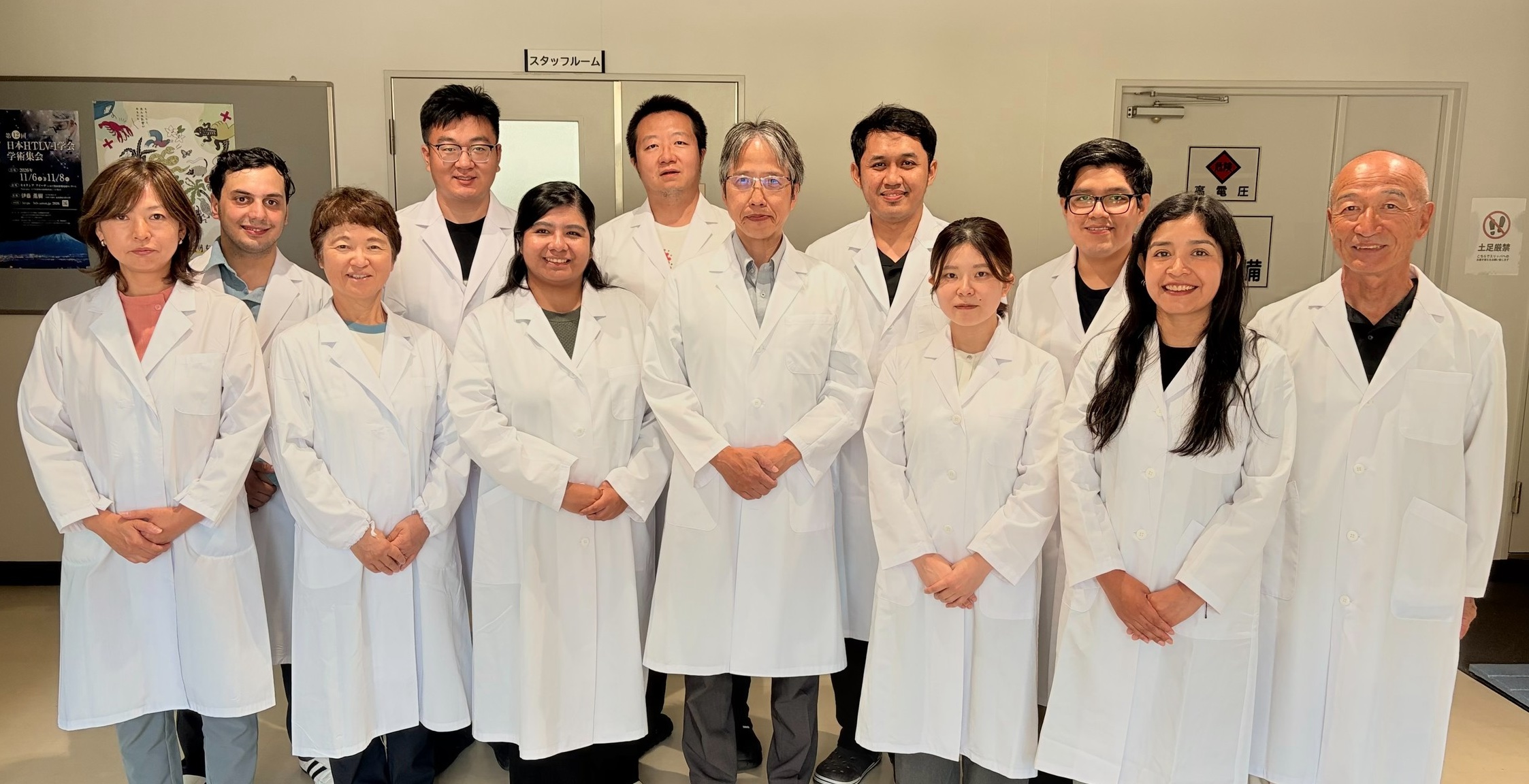
Members
Professor: Shingo Nakahata, PhD
Specially Appointed Assistant Professor: Jiazhou Li, PhD
Specially Appointed Researcher: Chikako Tani, DVM, PhD
Specially Appointed Researcher: Dimas Arya Abdillah, DVM, PhD
Technician/Secretary: Satomi Harazono
PhD student: Jhajaira Araujo
PhD student: Sophia Velarde
PhD student: Nao Nishikoba
MSc student: Alvaro Huamani
MSc student: Namli Atakan Zeki
Research student: Qiu Chenghui
Undergraduate student: Ryo Usuki
Visiting researcher: Mineto Tani, DVM, PhD
Alumni
Visiting researcher: Ahmed Goda, PhD (Professor, Tanta University, Egypt)
Undergraduate student: Shuhei Fujii
PhD student: Daniel Enriquez, MD
Contact
KAGOSHIMA UNIVERSITY Division of HTLV-1/ATL Carcinogenesis and Therapeutics, Joint Research Center for Human Retrovirus Infection
TEL. +81-99-275-6657
E-mail.snakahata[at]kufm.kagoshima-u.ac.jp
Please replace [at] with @ when emailing.
